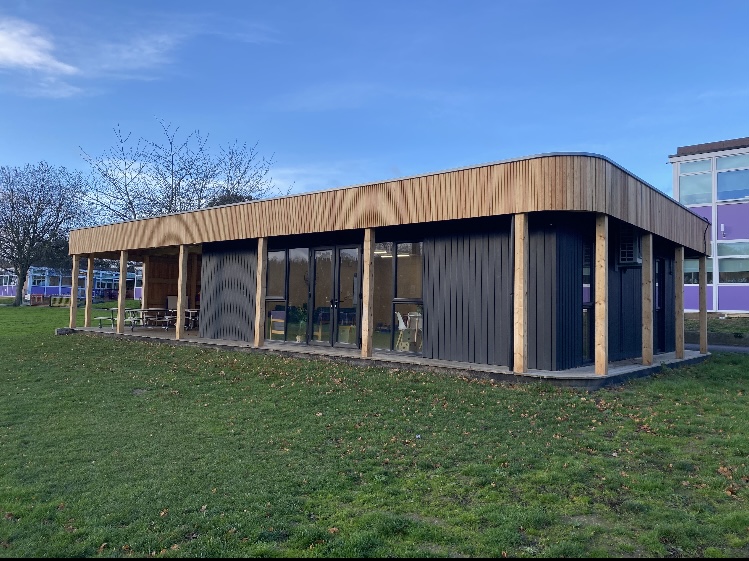
Funding Modular Classrooms & Nurseries 2026–27

Before looking at individual funding routes, it’s helpful to understand why modular buildings are often viewed positively by funders.
Modular construction typically offers:
- Faster delivery, helping schools respond to urgent space requirements
- Predictable costs with fewer unexpected overruns
- Flexible designs that can meet specific funding criteria
- Long-term durability comparable to traditional buildings
- Strong sustainability and energy-efficiency credentials
For many funding bodies, these factors make modular classrooms a practical, credible investment, rather than a short-term solution.
1. Government-Backed Funding Routes
Condition Improvement Fund (CIF) & School Condition Allowance (SCA)
The Condition Improvement Fund (CIF) and School Condition Allowance (SCA) are key capital funding routes administered by the Department for Education.
They are commonly used to support:
- Building condition improvements
- Replacement of unsuitable accommodation
- Expansion projects where need is clearly evidenced
- Health, safety and compliance works
- Energy-efficiency upgrades
Who these routes are typically for:
- Academies
- Small Multi-Academy Trusts (MATs)
- Voluntary-aided schools
- Sixth-form colleges
Modular classrooms often align well with CIF and SCA applications because they:
- Address urgent need quickly
- Provide durable, high-quality accommodation
- Demonstrate value for money
- Support sustainability and efficiency objectives
When presented clearly, modular builds can be positioned as future-proof solutions, rather than costly extensions.
Local Authority, Basic Need & Expansion Funding
Local authorities receive capital funding to support:
- Expansion of existing schools
- Creation of new school places
- Responding to local population growth
This type of funding is often time-sensitive, particularly in areas experiencing rising demand for pupil places.
Modular buildings are well suited because they:
- Can be delivered faster than traditional builds
- Allow schools to expand without prolonged construction programmes
- Provide flexibility if future needs change
For schools working with local authorities on capacity planning, modular construction is often viewed as a pragmatic and responsive solution.
2. Grants From Trusts, Foundations & Charities
Beyond government funding, many schools and nurseries explore grants from charitable trusts, foundations and community-focused organisations.
These grants often support:
- Early-years provision
- SEND facilities
- Outdoor learning environments
- Community-linked education spaces
- Capital improvements and refurbishments
This route is particularly relevant for:
- Nurseries and early-years settings
- Independent or faith schools
- Schools delivering specialist or SEND provision
- Community-run education spaces
Modular buildings work well in this context because they are:
- Flexible in layout and scale
- Suitable for specialist or bespoke spaces
- Adaptable to different budget levels
In many cases, charitable grants can be used alongside other funding routes, helping to bridge funding gaps.
3. Specialist Funding Programmes
Some funding streams are targeted at specific educational priorities, such as:
- SEND accommodation
- Early-years expansion
- Outdoor or alternative learning spaces
- Community-use or multi-purpose buildings
Modular construction is particularly effective for these programmes because:
- Spaces can be configured to precise requirements
- Accessibility and inclusion are designed in from the outset
- Projects can be delivered quickly to meet urgent needs
For schools addressing specialist requirements, modular buildings often align well with both practical and funding criteria.
4. Flexible Financing: Leasing & Phased Investment
Not all schools or organisations have access to full capital funding upfront.
In these cases, alternative financing approaches may be considered, including:
- Leasing modular buildings
- Phased payment structures
- Staged investment aligned to budget cycles
Modular construction supports this approach because:
- Costs are predictable and transparent
- Projects can be delivered in manageable phases
- Financial risk is reduced compared to traditional builds
This route is often explored by:
- Independent schools
- Nurseries and early-years providers
- Community organisations
- Settings managing cashflow carefully
5. Community, Fundraising & Sponsorship
For smaller schools and nurseries, community-led funding can play an important role.
This may include:
- PTA fundraising
- Donations from parents or alumni
- Community fundraising initiatives
- Local business sponsorship
- Crowdfunding or partnership funding
While these routes may not cover an entire project, they can:
- Contribute towards part of a modular build
- Fund specific features or fit-out elements
- Strengthen community engagement and support
Clear communication and a well-defined plan often make these efforts more successful.
How Eco Classrooms & Nurseries Support the Funding Process
At Eco Classrooms & Nurseries, we understand that funding decisions are rarely straightforward.
Our role goes beyond delivering buildings. We support schools and nurseries by:
- Discussing which funding routes may be appropriate
- Supporting early-stage budget planning
- Designing buildings that align with funding criteria
- Providing information to support funding applications
- Offering clear timelines and cost transparency
Whether funding is secured through a single route or a combination of sources, our aim is to help clients move forward with confidence.
Quick-Start Funding Checklist
If you are considering a modular school or nursery build for 2026–27, these steps can help you get started:
- Review your current estate and identify priority needs
- Clarify whether expansion, replacement or specialist space is required
- Speak with Eco Classrooms & Nurseries to explore suitable solutions
- Identify potential funding routes or combinations
- Begin early planning and funding applications where appropriate
Starting early often opens up more funding options and reduces pressure later on.
Planning Ahead for 2026–27?
Many schools and nurseries are surprised by how achievable modular projects become once funding routes are clearly understood.
If you are considering a new classroom, nursery or specialist space for the 2026–27 academic years, we are always happy to talk things through.
No pressure. No obligation. Just a clear conversation about what’s possible for your setting.

Sustainable Modular Buildings for Schools, Nurseries & Community Spaces
From nurseries and classrooms to multi-use community buildings, we design and build sustainable modular buildings across the UK, tailored to each site, built to last, and delivered with minimal disruption.


Explore Our Latest Insights
Discover innovative ideas for educational spaces.