Could Your School Receive SEND Capital Funding?
A school is more likely to be considered for SEND capital funding when its proposal addresses an evidenced local need, supports the local authority’s inclusion strategy and can be delivered realistically. That means demonstrating more than a general need for additional space.
Decision-makers will want to understand which children the project will support, why the existing estate is unsuitable, what the new provision will make possible and whether the site, budget and proposed timetable are credible.
There is no single national scoring system that guarantees funding for an individual school. Priorities will depend on each local authority’s SEND sufficiency plan, available allocation and local circumstances.
Key takeaways
- High Needs Provision Capital Allocations are controlled by local authorities, not individual schools.
- A proposal should respond to an evidenced local need rather than begin with a preferred building.
- The 2026/27 funding guidance places particular emphasis on inclusion within mainstream settings.
- Project readiness, site feasibility and realistic costs can influence whether an idea is deliverable.
- Schools should engage their local authority before investing heavily in detailed designs.
How does SEND capital funding reach schools?
The Department for Education has allocated £860 million of High Needs Provision Capital funding for the 2026/27 financial year. The funding is intended to create new places for the 2027/28 academic year and improve existing provision for children and young people with SEND or those requiring alternative provision.
The money is paid to local authorities. Schools and academy trusts do not submit direct applications to the Department for Education for a portion of the national fund.
Each authority determines how to use its allocation against local priorities and must explain its planned projects through its SEND reform planning and grant-assurance processes. The complete High Needs Provision Capital Allocations page includes the current guidance and allocations for individual authorities in England.
This means a school’s first audience is usually its local SEND, education sufficiency or capital team.
What could make one school a stronger priority than another?
The Department for Education does not publish a universal school-level scoring matrix for this funding. The following factors are therefore a practical interpretation of the outcomes and responsibilities set out in the 2026/27 capital guidance, not a guarantee of approval.
1. A clearly evidenced local need
A credible proposal should identify the problem it is intended to solve.
Evidence might include:
- Current and forecast demand for SEND places.
- The number and range of pupils whose needs cannot be met within existing accommodation.
- Pressure on local specialist provision.
- Limitations affecting accessibility or inclusion.
- Distance travelled by children to reach suitable provision.
- Gaps identified through the local authority’s sufficiency planning.
A proposal is generally more persuasive when it connects school-level evidence to a recognised area-wide priority.
Avoid beginning with “we want a new building”. Begin with the educational and operational need. The building is one potential response to that need.
2. A clear contribution to mainstream inclusion
The 2026/27 guidance encourages local authorities to increase the capacity of mainstream settings, particularly through inclusion bases and adaptations to the physical environment.
An inclusion base provides tailored teaching and specialist support within a mainstream setting. It may serve pupils who require additional help while allowing them to remain connected to their wider school community.
Decision-makers may therefore want to know:
- What needs the proposed provision would support.
- How pupils would access mainstream lessons and activities where appropriate.
- Whether expertise from the base could benefit the wider school.
- How the project fits existing local SEND pathways.
- Whether the space would improve access to suitable provision closer to home.
The case should focus on what the environment enables for pupils, rather than simply the amount of floor space created.
3. A design brief grounded in real needs
A generic classroom with a different label is not automatically a suitable SEND provision.
The design brief may need to consider acoustics, lighting, thermal comfort, accessible circulation, hygiene requirements, quiet areas, staff visibility, storage and safe indoor–outdoor movement. The relevant requirements will depend on the children and young people using the space.
The Department for Education’s Inclusive Education Estates guidance recommends assessing the experience of users across the whole site. It covers ten elements of inclusive design and practical adaptations to buildings and outdoor spaces.
For a building-specific overview, ECAN’s modular classroom design guide for SEND explains why specialist spaces should be designed around their users from the outset.
4. A site that has been assessed properly
Even a strong educational case can become difficult to deliver if the proposed site has not been investigated.
Early feasibility work should consider:
- Vehicle and construction access.
- Ground conditions and foundations.
- Drainage and existing utilities.
- Available space and site boundaries.
- Fire access and emergency arrangements.
- Safeguarding on a live school site.
- Relationships with existing buildings.
- Outdoor areas, parking and circulation.
- Potential planning constraints.
Not every issue will prevent a project, but unidentified constraints can affect its design, cost and timetable. A permanent modular building must still address planning and building regulations. ECAN’s guide to planning permission for modular classrooms explains the distinction between the construction method and the approvals a project may require.
5. A realistic and proportionate proposal
Decision-makers must consider what can be achieved with the available funding. A proposal should therefore distinguish between essential requirements, desirable features and options that could be added later.
A useful early cost plan should cover more than the building itself. Depending on the project, costs could include surveys, professional fees, planning, foundations, drainage, utility connections, external works, access improvements, specialist equipment and contingency.
Modular construction may offer programme and live-site advantages because elements are manufactured offsite, but it should not be presented as automatically cheaper or suitable for every project. The outcome depends on specification, scale, site conditions and the chosen procurement route.
6. Evidence of project readiness
A local authority may be more confident in a proposal where the school can demonstrate that key people are engaged and the next steps are understood.
That could include:
- Support from governors or the academy trust.
- Early engagement with the local authority.
- Input from the SENCO, estates team and teaching staff.
- Appropriate engagement with pupils and families.
- An initial site assessment.
- A defined capacity and accommodation brief.
- Awareness of planning, procurement and regulatory requirements.
- A realistic route from approval to occupation.
The Government expects local authorities to consult appropriately with parents, carers, young people and providers when developing their capital strategies. Schools should be prepared to contribute meaningful evidence rather than relying solely on internal assumptions.
A quick SEND capital proposal checklist
Before approaching your local authority, ask:
- Can we explain the unmet need in one clear paragraph?
- Does our evidence align with a recognised local priority?
- Have we defined who will use the provision and how?
- Have staff, families and relevant professionals contributed?
- Do we know whether adaptation or a new building is more appropriate?
- Has the proposed site received an initial feasibility review?
- Have we considered all likely project costs?
- Can we explain how the space supports mainstream inclusion?
- Do governors or trust leaders support further exploration?
- Do we know which local authority team should receive the proposal?
If several answers are “not yet”, the project may still be worthwhile. It simply needs further scoping before it is ready for a funding discussion.
What does a well-defined education-space brief look like?
The Prince Edward Primary School project demonstrates the value of beginning with a clear operational requirement.
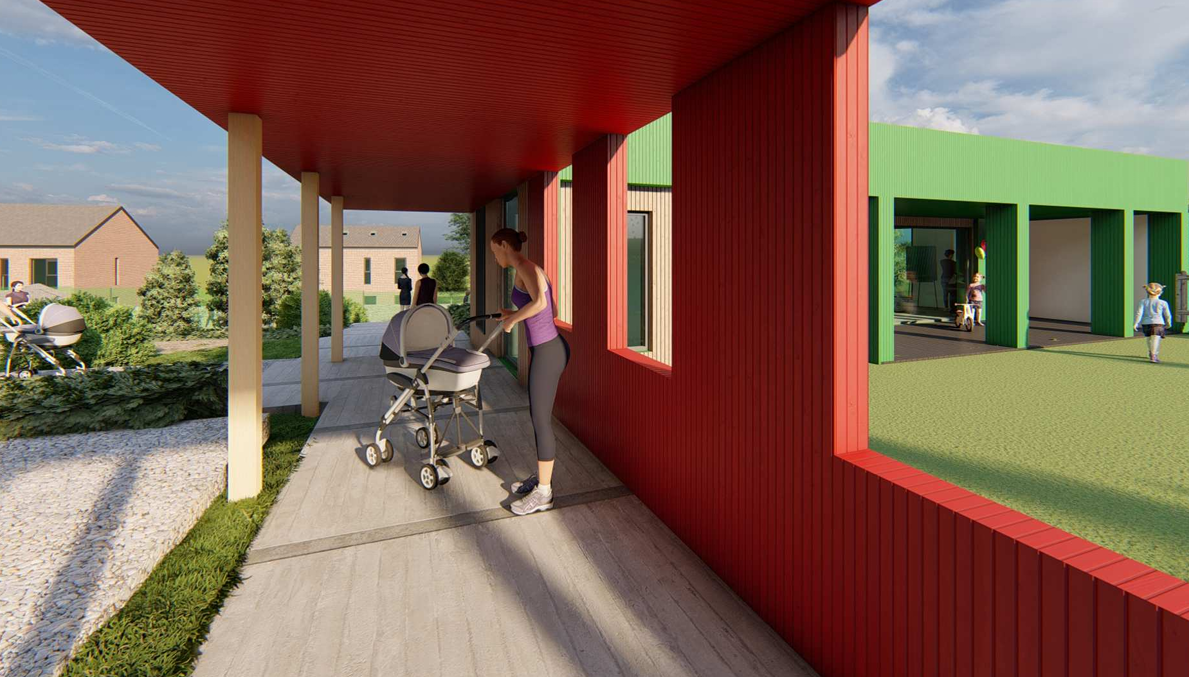
The school commissioned an 88m², purpose-built outreach centre in Sheffield to support families and wider community engagement. The resulting building was designed around the school’s identified needs and available budget rather than being based on a standard classroom layout.
This project is not presented as a SEND development or as a recipient of the 2026/27 capital allocation. Its relevance is the approach: the school could clearly explain who needed the space, how it would be used and why a purpose-designed building was required.
The same principle applies when preparing a SEND capital proposal. Before discussing materials or construction methods, schools should be able to define:
- The children and staff the provision will support.
- The activities and interventions it must accommodate.
- The limitations of the existing estate.
- The rooms, facilities and accessibility features required.
- How the project aligns with the available budget.
- What the space will contribute to the school and local area.
A clear brief gives local-authority decision-makers something tangible to assess and provides a stronger foundation for site feasibility, design and cost planning.
Make the need clear before choosing the solution
Schools cannot guarantee that they will be prioritised for SEND capital funding. They can, however, make it easier for decision-makers to understand the need, assess the proposal and determine whether it fits local plans.
If you are considering an inclusion base, intervention room or specialist SEND space, contact Eco Classrooms & Nurseries with your location, site information, required capacity and intended timetable. The team can help you explore what may be realistic before detailed decisions are made.
Follow Eco Classrooms & Nurseries on LinkedIn for further guidance on SEND provision, project planning and modular education buildings.
Frequently asked questions
Does having pupils with EHCPs guarantee capital funding?
No. Individual pupil needs may form part of the evidence, but funding decisions depend on local priorities, available capital and the overall proposal.
Should a school commission detailed designs before contacting the council?
Usually, early engagement is sensible before committing substantial resources. The local authority may have specific requirements or alternative plans for the area.
Will a modular building improve the chance of receiving funding?
Not automatically. Decision-makers should consider the need, suitability, value and deliverability of the project rather than approving it solely because it uses modular construction.
Can funding be used to adapt an existing building?
Potentially. Current guidance permits adaptations that improve the inclusivity and accessibility of mainstream environments, subject to local approval.
Is the 1 October 2026 return a school application deadline?
No. It is the deadline for local authorities to return their grant-assurance information to the Department for Education. Local processes and timescales may differ.

Sustainable Modular Buildings for Schools, Nurseries & Community Spaces
From nurseries and classrooms to multi-use community buildings, we design and build sustainable modular buildings across the UK, tailored to each site, built to last, and delivered with minimal disruption.


Explore Our Latest Insights
Discover innovative ideas for educational spaces.