£860m SEND Capital Funding Explained for Schools

The Government’s £860 million SEND capital funding allocation is intended to create new places and improve existing provision for children and young people with special educational needs and disabilities in England. The money is allocated to local authorities, rather than directly to individual schools, and is expected to support greater inclusion within mainstream education.
For schools, the practical question is not simply whether funding exists. It is whether their proposed SEND space responds to an evidenced local need, is suitable for the pupils who will use it and is sufficiently developed for the local authority to consider.
Key takeaways
- The £860 million is a capital allocation for the 2026/27 financial year in England.
- Local authorities receive and decide how to use the funding against local priorities.
- Schools cannot assume that they will receive funding automatically.
- Eligible projects can include inclusion bases, accessibility improvements and specialist facilities.
- Early site assessment, educational scoping and dialogue with the local authority can strengthen a proposal.
What is the £860 million SEND funding?
On 25 March 2026, the Department for Education published £860 million of High Needs Provision Capital Allocations, commonly shortened to HNPCA, for the 2026/27 financial year.
According to the Department for Education’s explanatory note, the funding is intended to help local authorities deliver new places for the 2027/28 academic year and improve existing provision for children and young people with SEND or those requiring alternative provision.
This is capital funding. It can pay for buildings, physical adaptations and other qualifying capital expenditure, but it cannot be used for revenue costs such as staff salaries or training.
The funding applies to England and should not be confused with separate SEND funding arrangements in Scotland, Wales or Northern Ireland.
Who receives and controls the SEND capital funding?
The funding is allocated to local authorities. Individual schools, academy trusts and nurseries do not automatically receive a share or submit a direct national application to the Department for Education.
Local authorities can decide how best to use their allocation across the 0-to-25 age range, based on local sufficiency planning and identified needs. The Government is particularly encouraging investment in mainstream settings, from early years through to post-16 provision.
Schools that need additional SEND capacity should therefore speak to the relevant teams within their local authority. Depending on the area, this may involve:
- The SEND or inclusion team.
- Education sufficiency and place-planning officers.
- The education capital or estates team.
- Early-years or post-16 commissioners.
- Local authority procurement and property teams.
The strongest starting point is a clearly evidenced problem, not a pre-selected building. A local authority will need to understand who requires the provision, what needs are currently unmet and how the proposed project fits its wider SEND strategy.
What can SEND capital funding cover?
The current High Needs Provision Capital Allocations guidance identifies several potential uses.
Inclusion bases in mainstream settings
An inclusion base provides tailored teaching and support within a mainstream school or setting. It can allow pupils to receive specialist support while remaining connected to their local school community.
The guidance anticipates investment in specialist bases commissioned by local authorities and support bases commissioned by individual settings or academy trusts.
Creating a base could involve adapting existing accommodation or constructing a new, purpose-designed space.
Adaptations to mainstream buildings
Funding can support physical changes that make an existing estate more inclusive and accessible. Examples in the official guidance include:
- Improved acoustics and lighting.
- Calm, quiet or low-stimulation spaces.
- Accessible changing and hygiene facilities.
- Ramps, handrails and improved circulation.
- Outdoor learning environments.
- Improvements that make classrooms suitable for a wider range of needs.
The DfE’s new Inclusive Education Estates guidance provides a practical framework for assessing how children and young people experience the whole site, rather than treating inclusion as a feature of one room.
Special-school and alternative-provision places
Local authorities may also invest in special-school or alternative-provision capacity where appropriate. However, the 2026/27 arrangements place a strong emphasis on mainstream inclusion. Authorities planning additional special or alternative-provision places are expected to provide an evidence-based explanation of why the identified need cannot be met in a mainstream setting.
What is not covered?
The allocation cannot be used for general maintenance, staff costs or training. Schools should not assume that every accessibility, condition or expansion project will qualify simply because it benefits pupils with SEND.
The proposed expenditure must fit the funding conditions and the local authority’s agreed capital strategy.
What happens next?
Local authorities were expected to submit the first iteration of their local SEND reform plans in June 2026. They must also return a grant-assurance template to the Department for Education by 1 October 2026, outlining the projects they intend to support.
Importantly, 1 October is a local-authority reporting deadline, not a direct application deadline for schools. The DfE acknowledges that not every allocation will necessarily be committed by that date.
However, schools should not interpret this flexibility as a reason to delay. Developing a credible proposal takes time, particularly where site access, drainage, utilities, planning, procurement or building regulations need to be considered.
What should a school prepare before approaching its local authority?
A useful initial proposal should answer six questions:
- What problem are we trying to solve?
Define the unmet need, current capacity pressure or limitation of the existing estate. - Who will use the space?
Explain pupil numbers, age range and relevant educational, sensory, mobility or support requirements without disclosing unnecessary personal information. - Why is the current accommodation unsuitable?
Use evidence from staff, estate reviews and appropriate engagement with pupils and families. - What type of environment is required?
Consider teaching rooms, intervention areas, calm spaces, hygiene facilities, storage, outdoor access and staff visibility. - Is the site realistic?
Access, ground conditions, utilities, drainage, safeguarding and the effect of construction on a live school must be assessed. - What approvals may be needed?
Funding approval does not remove the need to address procurement, planning permission, building regulations or relevant education-estate standards. The DfE publishes separate school design and construction guidance covering areas such as space, fire safety, ventilation and acoustics.
A permanent modular building may be one option where the school needs a bespoke space with much of the construction completed away from the live site. It should still be compared objectively with adaptation, refurbishment and traditional construction routes.
Turning an identified need into a suitable space
The Eco Classrooms & Nurseries SEND design guide explains why a specialist environment should begin with the needs of its users rather than a standard classroom layout.
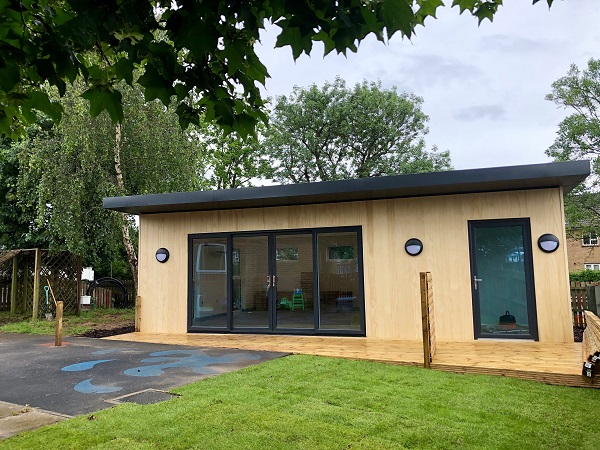
One relevant example is the bespoke support space at St Louis Academy. The 20m² modular building was designed as a calm environment supporting children, families and support teams. It demonstrates how a relatively focused project can respond to a specific operational requirement.
This project is not presented as an example of a building funded through the 2026/27 HNPCA programme. It is included to illustrate the importance of designing around the intended use.
Eco Classrooms & Nurseries works with schools and other organisations from initial site discussions through bespoke design, planning, building regulations, offsite construction, assembly, handover and aftercare. You can also explore its wider guidance on funding modular classrooms and education spaces.
The practical lesson for schools
The £860 million allocation creates an opportunity to improve SEND provision, but funding alone does not create a successful space. Local need, educational suitability, site feasibility and project readiness must connect.
If your school is considering an inclusion base, intervention space or specialist modular classroom, contact Eco Classrooms & Nurseries with your site, required capacity and intended timetable. The team can help you understand what may be realistic before your proposal progresses further.
Follow Eco Classrooms & Nurseries on LinkedIn for practical guidance on SEND spaces, education-estate planning and sustainable modular buildings.
Frequently asked questions
Can an individual school apply directly for this SEND funding?
Not through the national HNPCA process. The allocation is paid to local authorities, which determine local priorities and projects.
Can the funding pay for a new modular SEND building?
A modular building may be considered where it meets the funding purpose and local strategy. The construction method does not make a project automatically eligible.
Does a funded modular building still need planning permission?
Funding approval and planning consent are separate matters. Planning requirements must be assessed for the specific building and site.
Can the money be used to improve an existing classroom?
Potentially. The guidance allows adaptations and improvements that make mainstream environments more inclusive, subject to local approval and the funding conditions.
Is the £860 million available across the whole UK?
No. The published High Needs Provision Capital Allocation applies to local authorities in England.

Sustainable Modular Buildings for Schools, Nurseries & Community Spaces
From nurseries and classrooms to multi-use community buildings, we design and build sustainable modular buildings across the UK, tailored to each site, built to last, and delivered with minimal disruption.


Explore Our Latest Insights
Discover innovative ideas for educational spaces.