Can a Modular Classroom Be Built While School Is Open?

Can a Modular Classroom Be Built While School Is Open?
Yes, a modular classroom can be built while a school remains open, provided the site can be safely separated and the work planned around pupils, staff and daily routines.
At Eco Classrooms & Nurseries, we regularly work on occupied education sites. One example is the sixth form centre at St Benedict’s Catholic School in Bury St Edmunds, built while the school remained open. The building programme had to accommodate the school’s day-to-day activities.
That does not mean construction goes unnoticed. There will be deliveries, machinery and some noise. The important question is how those activities are managed, and whether the proposed arrangements are right for your setting.
For headteachers and school business managers, this can change the starting point of an expansion project. Waiting until the summer holidays is not always necessary. But deciding to build during term time needs more than a promise of minimal disruption.
Here is what should happen before work starts, what to expect during construction, and when a holiday build is the better choice.
What does building on a live school site involve?
A live site is one where teaching, care or other normal activities continue alongside construction.
The school day becomes part of the build programme. Breakfast clubs, playground use, lunchtime movements and after-school collections all need to be understood before access arrangements are agreed.
At EcoClassrooms and Nurseries, our approach includes a construction health and safety plan, fenced working areas separated from children, and deliveries timed around parent drop-off and pick-up.
For a school assessing a proposal, those arrangements should be visible on a site plan. You should be able to see where the construction boundary sits, how workers reach it, and which areas remain available to pupils.
Secure boundaries and separate routes
The construction area needs suitable fencing or hoarding, controlled entry points and arrangements to prevent unauthorised access. Materials and equipment must remain secure, including when workers leave.
The Health and Safety Executive’s guidance on protecting the public highlights the need to plan and maintain boundaries, manage vehicle movements and give particular consideration to children.
For your school, ask how the proposed boundary affects daily movement. Can pupils still reach toilets, dining spaces and outdoor areas safely? Are accessible routes maintained? Can emergency services reach the occupied buildings?
These questions need answers before the working area is established.
Deliveries around the school day
A delivery slot should account for everyone using the site, including nursery families arriving throughout the morning and transport serving pupils with additional needs.
Where possible, construction traffic should use a separate entrance. Where access must be shared, the programme needs controlled delivery windows and clear responsibility for managing movement.
Ask what happens if a vehicle arrives late. An agreed schedule is useful only if the team also knows what to do when it changes.
Why offsite manufacture reduces disruption
The main advantage of modular construction is that some of the work happens away from the school.
Our buildings use structural insulated panels, or SIPs, manufactured offsite before assembly. This moves panel production into a factory and reduces the amount of construction required beside occupied classrooms. Groundworks can also progress while panels are being manufactured.
These are permanent, bespoke buildings designed around the setting. Offsite manufacture describes how their components are made.
We plan the build around the school’s wider programme, including funding, design and permissions, which can take considerably longer than the on-site work. Depending on the building’s size, on-site assembly can take four to six weeks. Site preparation, service connections and handover also need to be accounted for before an opening date is agreed.
For school leaders, the useful question is: which activities happen on our site, and on which dates?
Ask for the programme to distinguish groundworks, assembly, fit-out, connections and final checks. That gives you a clearer picture of when particular areas will be unavailable.
Our guide, How Long Does a Modular Classroom Take to Build?, explains the wider process. If you are still comparing construction methods, see Modular vs Traditional Build for Schools: Full Comparison (2026).
How ground screw foundations can help
Foundations affect how much activity takes place before the classroom begins to take shape.
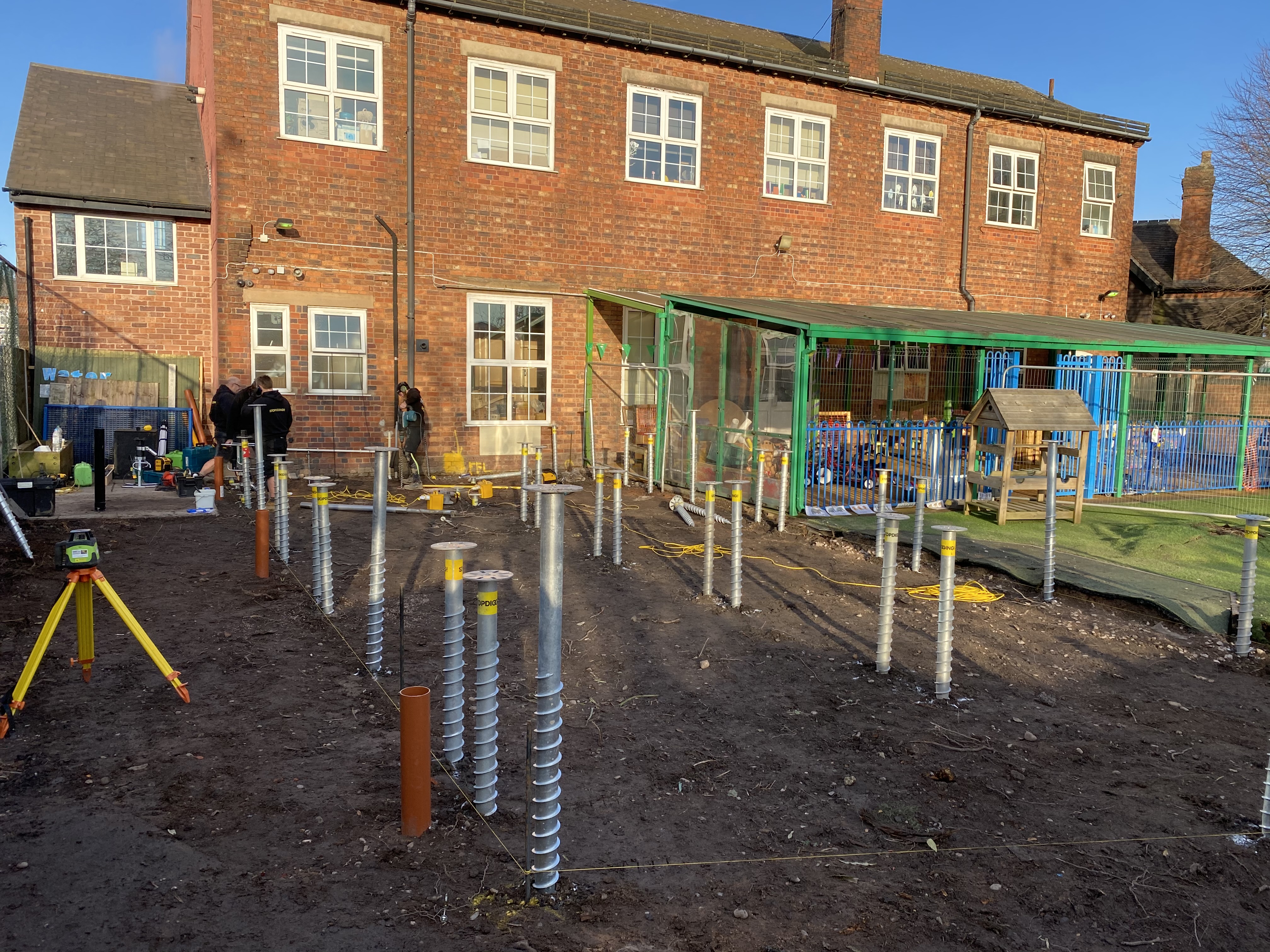
Where suitable, ground screws can reduce the excavation and concrete work associated with conventional foundations. Steel screws are installed into the ground to support the building, without waiting for poured concrete foundations to cure. Ground screw manufacturer Stop Digging explains this process in its guide to ground screw foundations.
On one of our projects, a specialist contractor installed 18 structural ground screws more than 800mm into solid bedrock. The supporting timber ring beams and rigid SIPs floor were mechanically secured across the foundation grid to resist movement. This was a project-specific solution: the number and depth of screws, and how the building is secured, depend on the ground conditions and structural requirements.
For an occupied school, avoiding extensive digging, spoil removal and concrete deliveries can make this stage less intrusive. Installation can also be quieter than foundation work involving prolonged excavation and breaking out.
That does not make it silent. Machinery is still involved, and ground conditions affect the equipment and preparation required. Drainage and utility connections may still need excavation.
The foundation design must suit the ground and the building’s loads. Buried services also need to be identified before installation. HSE guidance on avoiding danger from underground services explains why planning and locating services matter.
This is why an early site assessment is so valuable. Our article, What Our Due Diligence Caught Before It Became the School’s Problem, shows how an existing drainage issue can change the work needed.
What about safeguarding and DBS checks?
Safeguarding arrangements should be agreed before contractors arrive. They need to cover access, identity checks, supervision, conduct and how concerns are reported.
For schools and colleges in England, Keeping Children Safe in Education says safeguarding requirements should be included in the contractor’s contract. The appropriate DBS check depends on the work and the opportunity for contact with children.
Contractors undertaking regulated activity require an enhanced DBS check with children’s barred list information. Other contractors with opportunities for regular contact require an enhanced check without barred list information. Where there is no opportunity for regular contact, the school should consider whether a basic check is appropriate.
The guidance also says unchecked contractors must not work unsupervised or undertake regulated activity. Contractor identity should be checked on arrival.
The school’s safeguarding lead should help agree the arrangements. Schools outside England, and standalone early years settings, need to use the guidance applicable to their jurisdiction and provision.
DBS checks are one part of this preparation. Secure boundaries, controlled access and clear reporting arrangements remain essential throughout the project.
When are the school holidays the right choice?
Term-time construction should be an option to assess, never a target to achieve regardless of the consequences.
Some settings need a quieter programme. Others have access constraints that make occupied-site working impractical.
SEND and sensory-sensitive settings
Noise, vibration, unfamiliar people and changes to familiar routes may be particularly difficult for some pupils.
The decision should involve staff who understand those pupils’ needs. A fenced boundary may manage physical separation while doing little to reduce the impact of nearby drilling or machinery.
In these circumstances, completing disruptive work during a closure can be the right approach. That might mean scheduling foundations and assembly during holidays, or placing the whole on-site phase within a closure where feasible.
The same consideration applies to sensory-sensitive pupils in mainstream schools.
Our Modular Classrooms for SEND: Design Guide for Schools explores the finished learning environment. The construction programme deserves the same attention to individual needs.
Exams and other protected periods
Give your contractor exam dates before the programme is agreed.
Include mock exams, assessments, performances and other activities where noise or changed access would cause problems. Depending on the layout, particular operations may need to pause or move outside school hours.
Being able to continue ordinary lessons does not automatically mean every planned activity can continue unaffected.
Very constrained sites
Some schools have a single entrance, narrow circulation routes or little space for materials and deliveries.
If construction access cannot be safely separated from school activity, holiday working or temporary changes to provision may be necessary. The available playground and emergency access also need consideration.
A realistic proposal should identify those limitations early.
Can larger projects be built in phases?
Larger projects may benefit from dividing the work into manageable stages.
For example, site preparation might take place during a closure, followed by assembly within a secured area during term. Connections to existing buildings could then be scheduled for a later holiday or weekend.
These are options to investigate, rather than a standard sequence for every school.
Phasing needs to work operationally as well as technically. A completed room cannot necessarily open if access, fire precautions or essential services depend on unfinished areas.
Ask the project team to explain:
- Which areas remain available at each stage.
- Whether completed spaces can be handed over and used independently.
- When utility interruptions or temporary relocations may be needed.
- How boundaries and routes change between phases.
- What happens if one stage takes longer than expected.
Phasing can reduce the impact at any one time. It can also extend the overall programme or add costs through repeated mobilisation. Those trade-offs should be clear before the school commits.
What should the school prepare in advance?
The contractor needs to understand how your school actually operates. A site drawing alone will not show where families queue or when pupils need a particular outdoor space.
Share the full operating timetable
Include breakfast clubs, after-school provision, nursery hours, transport arrangements, lettings and holiday activities.
An apparently empty school may still be hosting a club or community group. Build planning needs to account for everyone who uses the site.
Identify the spaces you cannot lose
Explain which routes, entrances, play areas and facilities must remain available.
Where temporary changes are possible, agree them early. Staff should have time to plan supervision and explain changes to families.
Provide existing site information
Share available drainage plans, utility information, surveys and details of previous building work.
Tell the team about known problems, including unreliable drainage or access restrictions. Flag missing or uncertain records so these can be investigated before the programme is fixed.
Agree communication and decision-making
Nominate a school contact and a contractor contact, with deputies where needed.
Agree how upcoming work will be communicated, how urgent concerns will be raised and who can authorise changes. Decide who will update parents and staff about revised entrances, delivery activity or temporary restrictions.
A short, regular update can help the school prepare for the coming week.
Plan the move into the building
Allow for furniture, equipment, staff familiarisation and any arrangements needed before pupils arrive.
Agree what must be complete before occupation, how outstanding minor items will be managed, and who the school contacts afterwards. Construction finishing and teaching starting are separate milestones.
You may not need to wait until August
A modular classroom can give schools more flexibility over when they expand. Offsite manufacture reduces work on the premises, while a carefully planned programme can accommodate an occupied setting.
The decision still comes back to your pupils, your site and the work involved.
A useful first conversation should establish where construction could take place, how daily routines would continue and which activities need a closure. From there, the team can assess whether term-time delivery, holiday working or a phased approach makes most sense.
The right programme gives your school the space it needs while protecting the education already happening around it.

Sustainable Modular Buildings for Schools, Nurseries & Community Spaces
From nurseries and classrooms to multi-use community buildings, we design and build sustainable modular buildings across the UK, tailored to each site, built to last, and delivered with minimal disruption.


Explore Our Latest Insights
Discover innovative ideas for educational spaces.